Architecture
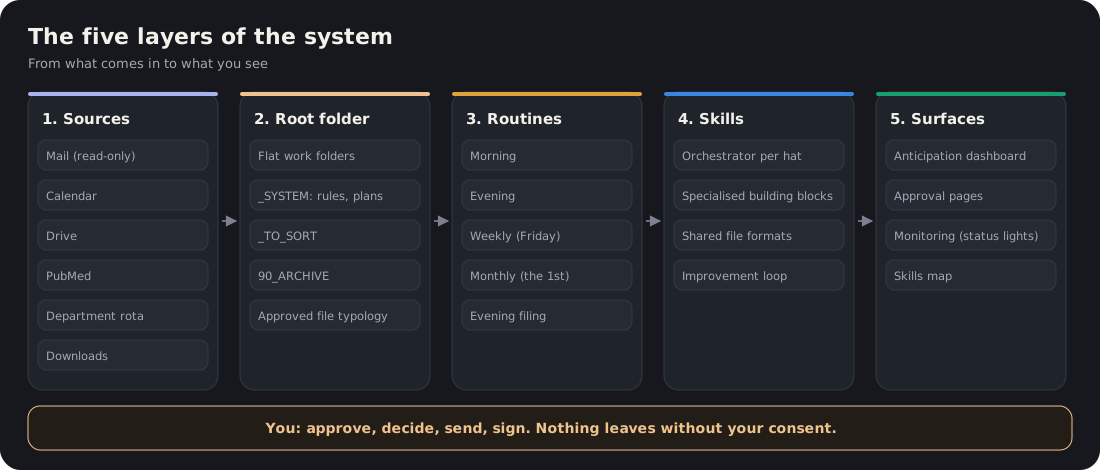
Figure 1. The five layers, from what comes in to what you see. Everything that goes out passes through your validation.
This page lists the building blocks of a system actually used for several months across all three missions, and points each one to the guide that describes it. It works as a map: if a building block is missing for you, this is where it shows up.
Overall organisation
| Layer | Role | Guide |
|---|---|---|
| Orchestrator per hat | Qualifies the request and routes it to the right building block, without doing the detail | Skills and hats |
| Anticipation dashboard | Single entry point: roadmap, ongoing projects, documents, deadlines | The Reactor |
| Scheduled routines | Morning, evening, weekly, monthly; driven by plan files | Routines |
| Root folder and file typology | What the AI sees, files and finds | Organising your files |
| Safeguards | Never overwrite, delete, send or write without approval | Safeguards |
| Email triage and calendar capture | What comes in, sorted by action | Triaging your email |
| Improvement loop | Corrections reviewed every week, skill updates proposed | Skills and hats |
| Cross-inventory | Every two months: what lies dormant, diverges or is missing | Cross-inventory |
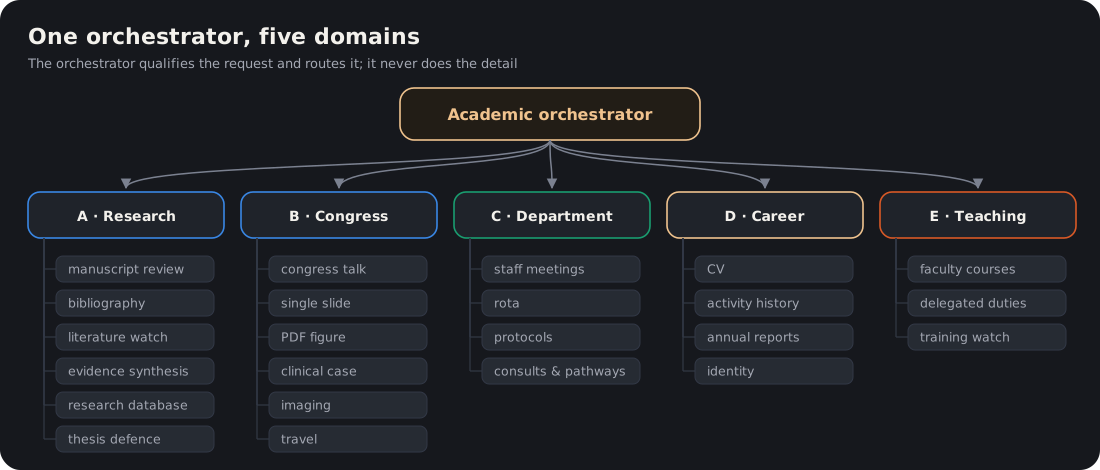
Figure 2. One orchestrator per hat routes to five domains; each domain calls its own building blocks.
A · Research and publications
| Building block | What it does | Guide |
|---|---|---|
| Article or thesis review | Three levels, tracked changes, verified references, arbitration between co-authors | Reviewing a manuscript |
| Manuscript portfolio | Role, reference version, locks before submission, follow-up after submission | Tracking your manuscripts |
| Peer reviews for journals | Sorting invitations, predatory publishers, batch declines | Reviews and requests |
| Thesis defences | Detection at D-14, full or short brief, documents to bring | Thesis defence |
| Literature review | Exhaustive search, tick-box sorting, synthesis and slides | Literature review |
| Literature watch | Topic feeds, journal whitelist, digest, “make the slide” | Literature watch |
| Research database | Core datasets per disease, freezing, pseudonymised index, aggregate queries, sensitive-data drawer | Database |
| Studies and cohorts | Status, backward-planned milestones, versioned analysis plan, site set-up | Studies and cohorts |
B · Conferences and talks
| Building block | What it does | Guide |
|---|---|---|
| Conference presentation | Scoping, slide bank, validated sourced outline, versions, speaker notes | Conference presentation |
| Single slide | Check or add a reference, bring back to the template, extract a figure | Working on a slide |
| Online conference material | Useful pages from the platforms you subscribe to | Conference presentation |
| Clinical cases | Four-slide template, numbered compilation | Building a clinical case |
| Imaging | Anonymised export, sorting of sequences, animated loops, comparison between visits | Imaging |
| Travel | Tickets, programme, itinerary, points of attention | Travelling to a conference |
| Calendar of requests | Date conflicts, media, absence quota | Arbitrating requests |
C · Department and care
| Building block | What it does | Guide |
|---|---|---|
| Staff meeting | Bank of talks, topics never covered, slot scheduling | Staff meeting talk |
| Department schedule | Read-only, cross-checked with the academic calendar | Schedule |
| Scheduling tool | Template schedule, tabs per activity, monthly view, shared database, publication | Building the tool, the full case |
| Absences and stand-ins | Absences ↔ email, freed-up rooms, replacements per half-day | Absences and stand-ins |
| Schedule delivery | Triple test, double check, publication in four clicks | Publishing the schedule |
| Organising staff meetings | Recurring meetings, index, semester programme | Organising staff meetings |
| Department project | Material for hospital management, medico-economic section | Department project |
| Event | Agreement, contacts, day plan, press | Organising an event |
| Unit report | Official template filled in without reformatting | Activity report |
| Protocols and procedures | Reading, validating and circulating minutes, standard week | Protocols |
| Consultations and care pathways | Requests for opinion, referrals, multidisciplinary meetings, recurring staff meetings | Consultations and pathways |
D · Career
| Building block | What it does | Guide |
|---|---|---|
| CV, history, reports | A single data sheet, monthly log to validate, derived documents | Career file |
| Statutory career path | Steps, requirements, official texts | Career paths |
E · Teaching and training
| Building block | What it does | Guide |
|---|---|---|
| Faculty | Annual cycle, D-30 / D-15, MCQs, OSCEs, leads | Lectures and MCQs |
| University diploma | Start of the academic year, mailing list, calendar, decisions | Starting a DIU |
| Supervision | Following theses and dissertations, reminders | Supervising a thesis |
| Delegated missions | Leads, distribution among junior staff, annual cycle, faculty watch | Teaching missions |
| Continuing education | Weekly watch of training platforms | Training watch |
Boundaries to keep
- The payer decides where it belongs. A scientific talk funded by industry is prepared with the same building blocks, but its filing, contract and invoicing fall under another hat.
- Expenses stay in finance. The scientific preparation of a conference belongs here; registration, train and hotel go to accounting.
- The schedule and the calendar are read-only. Proposals are made in the conversation; writing stays manual or subject to approval.
- A university diploma is a separate project, distinct from faculty teaching, with its own mailbox, its own files and its own watch.
Out of scope
Consulting for industry, accounting and personal life have their own organisation and do not appear on this site.